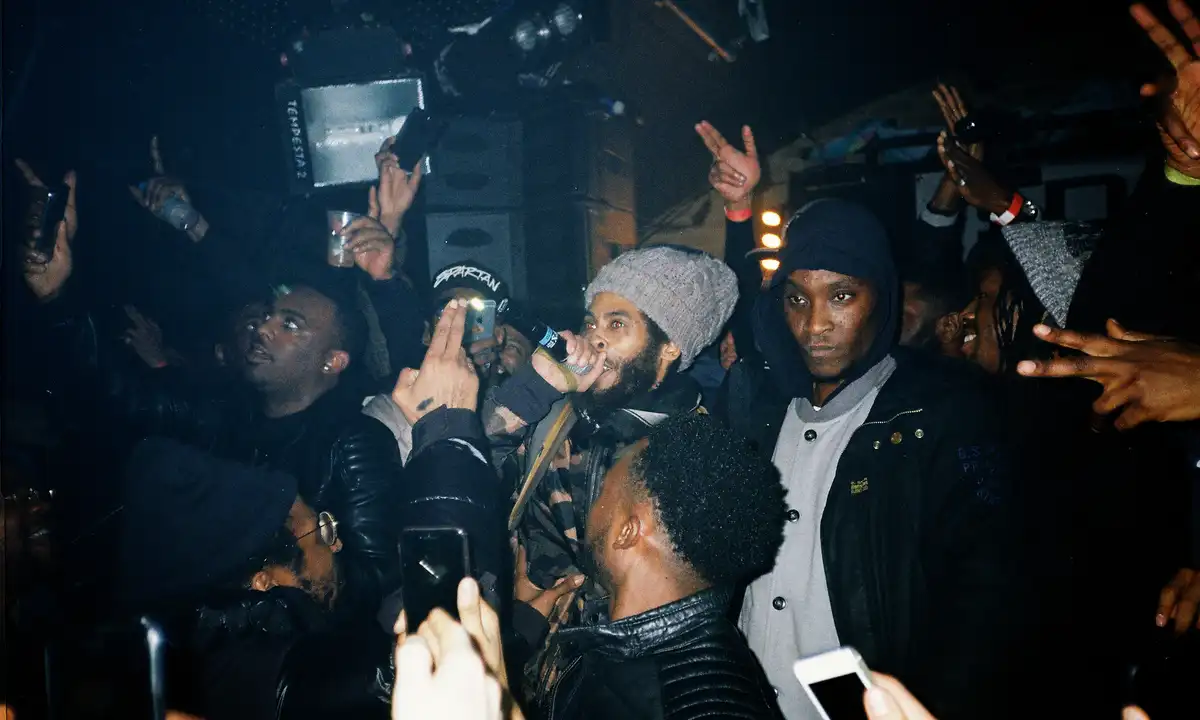
This site documents the technical, geographic, and visual history of UK grime and garage — two genres born in East and South London that reshaped British music without ever asking permission from the mainstream. It covers the MC techniques that separate skilled performers from imitators, the pirate radio stations that built the scene before streaming existed, the club photography that recorded raves nobody thought to preserve, and the economics that kept a DIY movement alive for two decades. Where music journalism tends to default to biography and chart positions, the material here focuses on craft, geography, and the visual record — the parts of grime's history that get thinner with every passing year.
What UK Grime Actually Is — and Why It Still Matters in 2026
Grime did not emerge from a record label boardroom. It came from pirate radio stations broadcasting across East London tower blocks in the early 2000s, from teenagers making beats on cracked copies of FruityLoops, and from MCs spitting over 140 BPM instrumentals that sounded like nothing else on earth.
The genre grew out of UK garage, jungle, and dancehall, absorbing elements from each without fully belonging to any of them. By the mid-2000s, grime had its own vocabulary, its own cadence, its own visual identity — and its own photographers, who were documenting it all before the music press paid attention.
In 2026, grime is no longer underground. It has BRIT Awards, arena tours, and Netflix documentaries. But the culture that produced it — the rave scenes, the pirate shows, the early mixtapes — remains less documented than it deserves. That gap is what this site exists to fill.
How UK Garage Became the Foundation of an Entire Generation's Sound
UK garage peaked commercially between 1998 and 2002. Labels like So Solid Crew's Relentless Records and independent distributors across South London were shifting records that fused American R&B rhythms with British production sensibilities — shuffled hi-hats, cut-up vocal samples, basslines that sat differently from anything coming out of Chicago or New York.
The 2-step rhythm that defined UK garage was not simply a tempo choice. It created space inside the beat — a syncopation that MCs eventually exploited. When producers like Wiley and Target began pushing the BPM up and stripping out the warmth, that space became aggressive, urgent, something new.
Key production characteristics that separated UK garage from its American counterparts:
- Tempo: 130–135 BPM (compared to US garage at 120–124)
- Vocal chops pitched up and fragmented rather than used melodically
- Sub-bass prominence borrowed from jungle
- Snare placement that resisted 4/4 predictability
- British slang and local reference in lyrics
The transition from garage to grime was not a clean break. Artists like Dizzee Rascal, Wiley, and Tinchy Stryder existed in both worlds simultaneously. The garage raves were still happening when the grime raves began. Some of the same crowds attended both.
The Geography of Grime: London Postcodes as Cultural Coordinates
Grime is not generically "London." The scene has always been hyperlocal, with distinct sounds and crews coming from specific areas:
| Area | Crews / Artists Associated | Sonic Character |
|---|---|---|
| Bow, E3 | Roll Deep, Dizzee Rascal | Raw, confrontational instrumentals |
| Lewisham, SE | Giggs, Ghetts | Darker, more street-narrative focused |
| Tottenham, N17 | Scorcher, Wretch 32 | Melodic elements, sports culture crossover |
| Brixton, SW9 | Krept & Konan, Stormzy | Gospel influences, heavier production |
| Romford / Essex border | Manga Saint Hilare | Outer London influence on East London sound |
This postcode specificity matters for understanding the music. When Dizzee Rascal referenced Bow on Boy in da Corner, he was not being abstract. The geography shaped the tension in the lyrics.
Club photography from this era shows the same localisation. Events at Plastic People in Shoreditch drew different crowds than those at Corsica Studios in Elephant and Castle, and the photographic records of both tell you something about how grime's social geography worked.
Pirate Radio and the Infrastructure Nobody Owns
Before Spotify algorithms and YouTube channels, grime ran on pirate radio. Stations like Rinse FM, Raw Mission, and DejaVu FM broadcast from residential flats, with aerials propped out of windows across East and South London.
Rinse FM is now licensed and globally respected. But in 2003, it was operating illegally, with Ofcom periodically raiding transmitters. The risk was real. So was the reach — Rinse had listeners across London and beyond, tuning in to hear sets from MCs and DJs who had no other platform.
What pirate radio gave grime that mainstream platforms have never fully replicated:
- Live improvisation, with MCs spitting over beats they had sometimes never heard before
- Clash culture — multiple MCs on one show, competing for the mic
- Audience feedback in real time via text message shoutouts
- Zero editorial filter — offensive, brilliant, experimental content coexisted
The grime documentary canon has covered some of this — Channel 4's Grime Kids adaptation and various Vice pieces — but the audio archive itself is fragmented. Recordings exist on old hard drives and cassette tapes, not in any centralised library.
MC Culture: The Craft of the Bar and Why Technical Skill Gets Undervalued
Grime MC-ing is technically demanding in ways that mainstream coverage rarely examines. The flow patterns used by artists like Kano, Skepta, and Ghetts involve:
Double time delivery: Fitting twice the syllables into a bar without losing clarity. Skepta's early material regularly hit syllable densities that would be difficult to transcribe accurately at normal speed.
Internal rhyme schemes: Grime MCs frequently rhyme not just at line ends but within bars — ABAB patterns within a single 16-bar verse are common.
Phonetic specificity: British pronunciation is not American. The short vowels in "North" and "South", the glottal stop replacing the "t" in words like "bottle", the regional vowel shifts — all of these are features grime MCs use deliberately to mark identity.
Instrumental matching: A skilled MC reads the break in a eski beat and adjusts delivery accordingly. This is a live performance skill that does not fully translate to studio recordings.
MC profiles that genuinely document this technical dimension — with reference to specific tracks, specific techniques, specific moments — do not exist widely online. Most coverage defaults to biography and commercial success metrics.
Club Photography as Historical Document
London club photography from the grime and garage era is culturally significant in ways that have not been fully recognised. The photographs taken at nights like Eskimo Dance, Lord of the Mics, and the early Boiler Room sessions are primary sources for understanding what this scene looked, felt, and dressed like.
What distinguishes serious club photography from snapshots:
- Light management: Raves operate in near-darkness with intermittent strobes and coloured lighting. Managing motion blur while preserving atmosphere requires specific technical choices — typically wide aperture, high ISO, and acceptance of grain as texture rather than flaw.
- Crowd dynamics: The best rave photography captures interaction — between performers and audience, between individuals in the crowd, between the space and the bodies in it.
- Moment selection: The decisive moment in a club setting is different from street photography. It might be the exact point of a lyric delivery, a reaction in the crowd, or the silhouette of a DJ against a light rig.
Photographers like Olivia Rose and Clara Molden documented aspects of this scene in ways that have been retrospectively recognised. But significant work was done by uncredited photographers working for free or for a pass into events, and much of that work has never been formally archived.
The social media archiving problem is real: Instagram has depreciated resolution on uploads consistently since 2015, and many images from the key period of grime's cultural expansion (2012–2019) exist only in compressed form online, with originals potentially lost.
The Grime Timeline: Key Moments That Shaped the Culture
Understanding grime in 2026 requires understanding the sequence of events that brought it from pirate radio to global recognition:
2003: Dizzee Rascal releases Boy in da Corner. It wins the Mercury Prize. Mainstream music press notices grime exists. The scene itself is unimpressed by this.
2005–2008: The commercial crossover period. Some artists attempt to align with American hip-hop aesthetics. The hardcore grime audience resists. This tension produces some of the most interesting music of the era.
2008–2012: Commercial grime largely fails. The underground scene continues. The Grime 2.0 debate begins — whether the genre can survive without commercial success, or whether it needs it.
2012: The Boiler Room grime sessions begin drawing international attention. Skepta performs for a room of fifty people that streams to hundreds of thousands.
2015–2016: Skepta's Konnichiwa, Stormzy's early mixtapes, the BRIT Award for Grime. The genre enters its second mainstream moment — this time on its own terms rather than through American mediation.
2018–2022: Grime artists headline Glastonbury, tour arenas, appear in fashion campaigns. The culture debate intensifies: is this still grime, or is it something else wearing grime's clothes?
2023–2026: A new generation of MCs emerges with different relationships to the history. Some have no memory of the pirate radio era. The documentation question becomes urgent.
UK Garage in 2026: Where the Sound Is Now
UK garage did not disappear — it mutated. Elements of the original garage sound resurfaced in bassline house (which dominated Yorkshire clubs from around 2005–2010), in the production work behind various UK pop acts, and in a conscious revival movement that has been building since approximately 2020.
Current artists working with garage-influenced production include producers who have never been to a 2001 UKG rave, operating entirely from online archives and sample packs. The result is sometimes historically accurate and sometimes genuinely novel — a third-generation interpretation of a sound that itself was a second-generation interpretation of American house and R&B.
The 2026 garage revival scene differs from the original in several ways:
| Factor | Original UKG (1998–2003) | Current Revival Scene |
|---|---|---|
| Distribution | Physical vinyl, pirate radio | Streaming, SoundCloud, Bandcamp |
| Dancefloor context | Licensed raves, illegal parties | Club nights, festival stages |
| Regional spread | South and East London primary | National, with strong scenes in Manchester and Bristol |
| International influence | US garage, house | Afrobeats, UK drill, Amapiano crossovers |
| Photography documentation | Analogue film, early digital | High-resolution digital, direct social posting |
Grime Documentaries and Visual Media: What Exists and What Is Missing
The documentary record of UK grime is better than it was five years ago, but it remains incomplete:
Existing documentation:
- Grime Kids (Channel 4 / Sky, adapted from DJ Target's book) — covers the early Rinse FM period with reasonable accuracy
- The Story of Grime (BBC Three series) — broad overview, stronger on commercial success than underground history
- Various Vice and Noisey short documentaries from 2012–2018 — inconsistent quality, often focused on individual artists rather than scene dynamics
- Lord of the Mics DVD series — direct documentation of clash culture, starting 2005
What is missing:
- Systematic documentation of the club nights and raves from 2000–2006
- Archival audio from pirate radio sets in searchable, preserved form
- MC technique analysis that goes beyond biography
- The economic history — how money moved through the scene, what the production and distribution infrastructure looked like before streaming
Photography archives fill some of these gaps. The images from early grime raves tell stories that verbal accounts sometimes compress or sentimentalise.
London Nightlife and Club Culture Beyond Grime
Grime and garage exist within a broader London nightlife ecosystem that has been significantly disrupted over the past decade. Club closures in London between 2010 and 2024 removed approximately 35% of the venue capacity that existed at the height of UKG:
- Fabric survived a temporary closure (2016) and remains central to London's electronic music identity, though its grime programming has been limited
- Plastic People (Shoreditch) closed 2015 — its absence is regularly cited as a loss to the scene
- Venue capacity constraints in Central London have pushed club culture south and east
The relationship between property development and club closure is documented and measurable. The Night Czar role, created by the Mayor of London in 2016, has had limited success in reversing the trend. A 2024 Night Time Industries Association report noted that while new venue openings had partially offset closures numerically, average capacity per venue had fallen.
For grime specifically, the loss of intimate venues matters culturally. The early scene was built in spaces that held 200–400 people. The move to arena-scale performance is not simply an upgrade — it changes the relationship between performer and audience fundamentally.
What Makes Good Grime Photography: Technical and Cultural Notes
For photographers working in this space, or for anyone trying to evaluate the work coming out of it:
Technical considerations:
- ISO handling: Modern mirrorless cameras (Sony A7 series, Nikon Z series) manage high ISO better than the Canon 5D that documented most of 2008–2014 grime. Grain character differs — more clinical at high ISO on contemporary sensors.
- Flash use: Direct flash is largely absent from serious grime photography, both for aesthetic reasons and because it disrupts the performance environment. Bounce flash off ceilings is sometimes used but ceiling heights and colours in UK clubs vary dramatically.
- Lens choices: 35mm and 50mm primes dominate, with 28mm for crowd-wide shots. Zoom lenses are rare — the focal length commitment forces compositional decisions.
Cultural considerations:
- Relationship between photographer and subject: The photographers who produced the best grime documentation were known to the MCs and promoters. Cold documentary photography from outside the culture produces different results.
- Image ownership: A persistent issue in club photography. Venues, promoters, and artists have all at different times claimed ownership of images taken at their events. Legal frameworks around this remain unclear.
- Publication context: Where an image appears changes its meaning. A grime rave photograph in Vogue carries different cultural weight than the same image on the photographer's personal site or in a self-published zine.
The International Reach of UK Grime: Export and Influence
By 2026, UK grime has influenced music production in ways that are detectable across multiple genres internationally:
- US hip-hop: Flow patterns from UK MCs appear in the work of American artists who have cited British influences. The 140 BPM eski beat influenced PC Music and adjacent hyperpop producers.
- Afrobeats and Afropop: UK-based artists of West African heritage created a documented hybrid sound (sometimes called UK Afrobeats) that drew on grime's production infrastructure and MC culture.
- French rap: The connection between French rap and London-based artists has been explicitly acknowledged by artists on both sides of the Channel, with cross-collaborations accelerating from 2018 onward.
- Nigerian Alté scene: Producers in Lagos have cited early Wiley instrumentals as influences, mediated through internet access to pirate radio recordings.
This international spread creates an interesting documentation challenge: the history of grime is partly a history of informal cultural transmission via the internet, pirate radio recordings uploaded to YouTube, and physical movement of people between cities.
Scene Economics: How UK Grime and Garage Actually Fund Themselves
The commercial structure of UK underground music has always been distinct from mainstream industry models:
Mixtape economy: Free mixtapes as promotional tools were central to grime's growth. Artists gave away music to build audiences, then monetised through live performance and merchandise. This model pre-dates the streaming era and in some ways predicted it.
Sound system and rave economics: Promoters in the early UKG and grime scene operated on thin margins. Entry prices at raves were low (typically £5–10 in 2000–2006 money), with revenue supplemented by bar takings and merchandise. Many nights ran at a loss and were sustained by enthusiasm rather than profit.
Physical product: Grime's relationship with physical releases is complex. Some of the most important early grime was released on white label 12" vinyl with no distribution infrastructure. Others skipped vinyl entirely, distributing through pirate radio and word of mouth.
Current streaming economics: A grime track generating 1 million streams on Spotify produces approximately £2,800–£3,500 in royalties at current rates, before label, management, and distribution fees. Independent artists retain a higher percentage but receive smaller per-stream rates on some platforms. This economic reality shapes what artists can sustain.
| Revenue Stream | Early Grime Era (2001–2008) | 2026 Reality |
|---|---|---|
| Physical sales | White labels, limited CDs | Minimal — vinyl for dedicated collectors |
| Live performance | Local raves, club nights | Primary income for established acts |
| Streaming | Not applicable | Volume-dependent, algorithmically mediated |
| Sync licensing | Rare | Growing — TV, advertising, games |
| Merch | Basic, often DIY | Significant revenue for major artists |
| Pirate radio | Cultural infrastructure, unpaid | Replaced by podcast and streaming sets |
Why Visual Archives of UK Club Culture Are Increasingly Valuable
Cultural historians, music researchers, and journalists increasingly look to visual archives when written documentation is sparse or unreliable. For UK grime and garage:
- Personal memory of rave attendees is selective and sometimes contradictory
- Mainstream music press coverage from 2001–2006 was limited and often condescending
- The artists themselves were not keeping systematic records
Photographs taken at the time fill these gaps in ways that are both more and less reliable than written accounts — more reliable because they capture what was actually worn, how spaces were arranged, what expressions looked like; less reliable because a single photographer's choices frame a particular view of events.
A photographic archive of UK club culture from this period is not nostalgia. It is primary source material for understanding a genuinely significant cultural movement that produced internationally recognised art with minimal institutional support.